
1. Why Users Search “Your Topics Multiple Stories”
The query “Your Topics Multiple Stories” reflects entity ambiguity, not curiosity about slang. Users encounter this phrase inside AI tools, content dashboards, collaborative editors, analytics interfaces, and structured chat environments, then attempt to decode its meaning as natural language.
Unlike casual texting abbreviations, this phrase functions as a descriptive system label, not interpersonal speech. Search intent behind this keyword is primarily:
- Informational: What does this phrase mean?
- Contextual: Why did I see it?
- Interpretive: Is this feedback, an error, or a classification?
- Practical: Should I change something?
Modern digital communication (2026+) increasingly blends human-readable language with machine-generated classification logic. This article explains the phrase as a semantic entity, not slang, and maps its meaning across platforms, contexts, and usage scenarios.
2. What Does “Your Topics Multiple Stories” Mean in Text?

Entity Definition
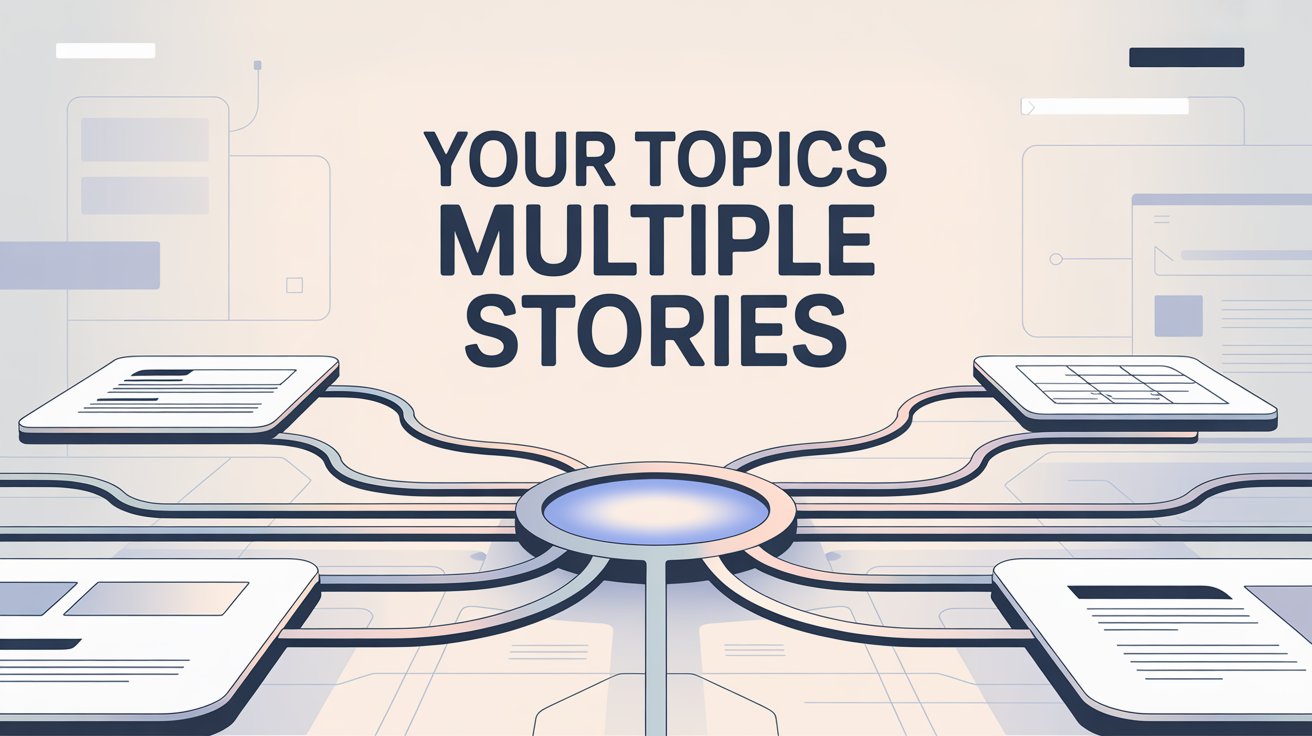
“Your Topics Multiple Stories” is a content-structure descriptor used to indicate that a single message, document, prompt, or conversation contains multiple topics or narrative threads instead of one unified focus.
Literal Semantic Breakdown
- Your Topics → the subjects introduced by the user
- Multiple Stories → more than one narrative path, angle, or thematic direction
Functional Meaning
The phrase signals topic dispersion or narrative fragmentation.
It does not describe fiction, dishonesty, or emotional storytelling. It describes structural complexity.
When It Does NOT Mean What Users Assume
- Not gossip-related
- Not slang for lying
- Not criticism of intelligence
- Not a tone judgment
The phrase is diagnostic, not emotional.
3. Is “Your Topics Multiple Stories” Slang, Typo, or Intentional Usage?
Slang Classification
This phrase does not qualify as slang:
- No cultural shorthand
- No informal contraction
- No generational markers
Typographical Error?
Unlikely. The phrase shows syntactic cohesion and intentional ordering.
Intentional System Usage
Most appearances come from:
- AI prompt analysis layers
- Content moderation systems
- Topic clustering engines
- Editorial feedback frameworks
- UX copy in dashboards
Contextual Identification Rule
If the phrase appears:
- Near filters, labels, or summaries
- Without punctuation or emotion
- In third-person structure
→ It is system-generated descriptive language.
4. Origin and Evolution in Digital Communication

Early Digital Communication
SMS and early chat favored brevity, not semantic labeling. This phrase did not exist in early mobile texting.
Emergence Through Platforms
The phrase emerged from:
- SEO tooling
- Content management systems
- AI prompt evaluation frameworks
- Recommendation and classification models
Generational Influence
Younger users normalize interface language as readable language. They interpret system phrasing pragmatically, not emotionally.
Persistence in 2026
The phrase persists because it:
- Compresses complex analysis into short text
- Avoids emotional bias
- Scales across languages and platforms
5. Real-World Usage Scenarios (Entity Context Mapping)
a) Casual Peer Communication
Rare, but appears in meta-commentary.
Example
“Your topics multiple stories—pick one and go deeper.”
Intent: Clarification
Tone: Light correction
b) Workplace and Professional Environments
Common in:
- Editorial feedback
- Strategy reviews
- Product documentation
- UX writing teams
Example
“This section shows your topics multiple stories. Consider separating them into distinct pages.”
Intent: Structural optimization
Tone: Neutral, professional
c) Online Communities, AI Tools, and Platforms
Frequent in:
- AI assistants
- Analytics panels
- Moderation dashboards
Example
“Detected: your topics multiple stories. Narrow the prompt for better output.”
Intent: Instructional
Tone: System-neutral
6. Emotional Tone and Intent Analysis
Default Emotional State
Emotionless by design. The phrase functions as technical language.
Tone Modifiers
- Emojis → soften perceived criticism
- Explanation → removes ambiguity
- Abrupt delivery → may feel cold
Perception Risk
When presented without context, users may project judgment where none exists. This is a human interpretation error, not linguistic intent.
7. Cultural and Regional Interpretation Differences

Native English Speakers
Interpret the phrase as structural feedback, not social commentary.
Non-Native English Speakers
Often misread:
- “Stories” as fiction
- “Multiple” as criticism
Cross-Platform Normalization
The phrase is increasingly understood as interface language, not conversational English.
8. Comparison With Semantically Related Terms
| Phrase | Core Meaning | Tone | Formality | Entity Role |
|---|---|---|---|---|
| Your Topics Multiple Stories | Topic dispersion | Neutral | Medium–High | Structural descriptor |
| Mixed messages | Conflicting intent | Neutral | Medium | Intent analysis |
| All over the place | Lack of focus | Casual | Low | Subjective critique |
| Too many angles | Over-complexity | Professional | Medium | Strategy feedback |
| Rambling | Excess verbosity | Negative | Low | Emotional judgment |
9. Common Misunderstandings and Errors
Misinterpretation Pattern
Users treat the phrase as:
- Personal criticism
- Tone feedback
- Narrative insult
Autocorrect Myth
No evidence supports autocorrect involvement.
Overuse Issue
Repeated use without clarification creates communication friction.
Best Practice
Always pair with:
- Explanation
- Recommendation
- Next action
10. Politeness and Professionalism Assessment
Relationship-Based
- Peer-to-peer: acceptable
- Manager-to-team: explain
- Client-facing: rephrase
Context-Based
- Feedback documents: appropriate
- Direct messages: risky
- Public comments: avoid
Professional Alternative Framing
- “This content covers multiple topics.”
- “There are several narratives here.”
11. Linguistic Expert Insight: Digital Language in 2026
Modern digital language prioritizes:
- Cognitive efficiency
- Machine interpretability
- Human readability
Phrases like this survive because they satisfy algorithmic clarity while remaining understandable to users. Grammar adapts to systems, not tradition.
12. How and When to Use “Your Topics Multiple Stories”
Appropriate Usage
- Content audits
- Prompt optimization
- Editorial feedback
- UX classification
Avoid Usage
- Emotional conversations
- Conflict situations
- Casual personal chat
Safer Semantic Alternatives
- “Multiple topics are present.”
- “The content lacks a single focus.”
13. Frequently Asked Questions (Entity-Based)
Is “Your Topics Multiple Stories” slang?
No. It is system-oriented descriptive language.
Is it negative feedback?
Not inherently. It signals structure, not quality.
Is it AI-generated?
Often, yes.
Does it relate to storytelling?
No. “Stories” refers to narrative threads.
Should I fix something if I see it?
Usually yes—by narrowing focus.
Is it acceptable in professional writing?
yes, with clarification.
Why do platforms use this phrasing?
It is scalable, neutral, and descriptive.
14. Final Summary and Key Takeaways
“Your Topics Multiple Stories” is a structural language entity, not slang. It describes topic dispersion within a single communication unit. The phrase originates from system-driven environments and persists because it efficiently communicates complexity without emotional bias.
Understanding this phrase improves:
- Content clarity
- Prompt effectiveness
- Professional communication
- Platform literacy in AI-driven environments
In 2026, fluency in interface language is part of digital competence.