

If you’ve ever wondered what does quid pro quo mean, you’re not alone. This Latin phrase has been part of English conversations for centuries, yet it continues to resurface in modern language, online chats, business talks, legal discussions, and even viral social media trends.
Where the Phrase Originally Appeared
The expression “quid pro quo” dates back to the early 1500s, originally used in medical and apothecary contexts. Pharmacists used it to describe accidentally (or intentionally) replacing one substance with another. It literally meant “something for something.”
By the 1600s, the phrase expanded into trade, negotiation, and everyday English communication. Whenever two parties exchanged something—whether a favor, service, gift, or opportunity—the phrase was used to describe the give-and-take relationship.
How It Became Popular
The phrase gained special momentum in:
- Political discussions
- Business negotiations
- Legal cases
- Pop culture references
- Internet slang
“Quid pro quo” surged on Google searches again in the early 2020s due to news coverage, HR rules about workplace behavior, and social media debates. The phrase became a shorthand way to explain unfair exchanges, hidden favors, or mutual benefit deals.
How The Meaning Evolved by 2026
By 2026, the meaning of “quid pro quo” evolved into a broader, more digital interpretation. While the core definition still means “an exchange of goods, favors, or benefits”, the modern understanding also includes:
- Digital favors (“Share my post and I’ll boost yours.”)
- Social exchanges (“I follow you if you follow me.”)
- Professional networking swaps (“You recommend me, I recommend you.”)
- AI-based interactions (“I give you data; you give me insights.”)
Today, the question “what does quid pro quo mean?” is more common in conversations about online culture, corporate ethics, and political transparency than ever before.
This guide breaks down everything you need to know about the phrase—its modern meaning, usage, examples, and its role in communication in 2026.
What Does “Quid Pro Quo” Mean in 2026?
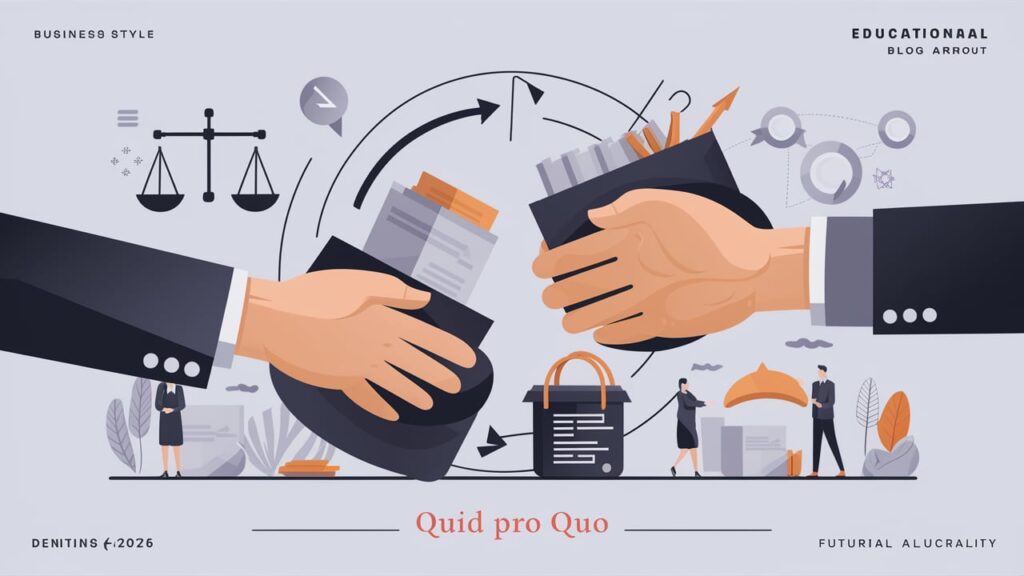
In 2026, quid pro quo still means “something given in exchange for something else.”
But the phrase has gained additional layers depending on context:
1. Ethical or Legal Meaning
A mutual exchange where one party receives a benefit only after providing something in return.
Example:
“Hiring someone only because they promised political support is considered a quid pro quo.”
2. Business & Corporate Meaning
A strategic agreement where both sides gain value.
Example:
“You promote our software, and we sponsor your event—classic quid pro quo.”
3. Digital Social Meaning (2026 Trend)
A reciprocal online exchange between creators, brands, or individuals.
Example:
“You tag my shop, I repost your video—quid pro quo collaboration.”
4. Negative Meaning (when misused)
An unfair exchange when one party holds power over the other.
Example:
“In workplaces, quid pro quo behavior can violate HR policies.”
Modern 2026 Definition
In a single sentence:
Quid pro quo in 2026 means a mutual exchange—digital, social, personal, or professional—where both parties gain something, but the fairness and ethics of the exchange decide whether it’s acceptable or problematic.
Modern Usage of “Quid Pro Quo” (2026 Edition)

By 2026, the phrase is used across professional, political, online, and casual settings. Each domain has its own flavor.
1. Business & Corporate Usage
Used to describe mutually beneficial deals, partnerships, and negotiations.
Example:
“Our partnership is not charity; it’s a quid pro quo.”
Corporations often use it when discussing:
- Sponsorships
- Brand collaborations
- Vendor agreements
- Strategic alliances
- Cross-promotion deals
2. Legal & Compliance Usage
Widely used in HR policies and legal frameworks, especially around harassment prevention.
2026 corporate training programs often explain:
“Offering a promotion in exchange for personal favors is illegal quid pro quo.”
3. Politics & Government
Used to describe exchanges where actions are traded for political benefits.
Example:
“He offered funding only if they supported the bill—classic quid pro quo.”
4. Social & Digital Media Usage
Influencers and digital marketers use the term daily.
Examples:
- “DM groups work on a quid pro quo system.”
- “Follow-for-follow is a social quid pro quo.”
5. Everyday Conversations
People use the phrase humorously or casually.
Example:
“I’ll wash the dishes, you make dinner—quid pro quo!”
“Quid Pro Quo” in Texting & Social Media (2026 Trends)

In 2026, social platforms like TikTok, Meta Threads, X (formerly Twitter), Instagram, and BeReal have their own interpretations of quid pro quo.
On TikTok (2026 Algorithm Culture)
Creators trade:
- Shoutouts
- Duets
- Feature swaps
- Trend participation
Usage:
“Let’s do a quid pro quo reel—I’ll react to yours if you stitch mine.”
On Instagram
Influencers perform mutual exchanges:
- Tag-for-tag
- Collab posts
- Story mentions
Usage:
“PR packages often involve a quid pro quo expectation.”
On X (Twitter)
People use it in political debates or sarcastic commentary.
Usage:
“So you defend him and he boosts your career? Quid pro quo energy.”
In Texting
Friends use it jokingly or informally.
Usage:
“Help me with my assignment and I’ll buy you coffee. Quid pro quo?”
Shortened forms sometimes appear:
- QPQ
- Q-for-Q
Examples of “Quid Pro Quo” in Real Chats (2026)
Example 1: Workplace Chat
Person A: Can you cover my shift tomorrow?
Person B: Sure, but I’ll need you for next Friday.
Person A: Deal. Quid pro quo.
Example 2: Social Media Creators
Creator A: Wanna collab?
Creator B: Yes! Quid pro quo—you feature my store, I feature yours.
Example 3: Politics (X Post)
“Funding was approved only after support was guaranteed. Sounds like quid pro quo to me.”
Example 4: Friends Texting
Friend 1: Want to borrow my charger?
Friend 2: Only if you buy snacks later.
Friend 1: Quid pro quo accepted 😂
Example 5: Business Negotiation
“We’ll provide the software licenses if you give us long-term exclusivity. Quid pro quo agreement.”
Misunderstood Meanings of “Quid Pro Quo”
While most people think they know what quid pro quo means, there are many misunderstandings:
1. Misconception: It Always Means Something Illegal
Not true. Many quid pro quo exchanges are ethical and normal.
Correct:
A fair exchange between two people is acceptable.
Incorrect:
Every exchange = coercion.
2. Misconception: It Only Applies to Politics
The phrase is used in:
- Business deals
- Social media collaborations
- Friendships
- Everyday conversations
3. Misconception: It Means “Payback”
“Payback” is revenge.
Quid pro quo is mutual exchange, not retaliation.
4. Misconception: It’s Always Negative
Positive examples exist:
- Skill swapping
- Team support
- Mutual promotions
- Partnership deals
5. Misconception: It’s an Old Phrase Not Used Anymore
It is used heavily in 2026, especially due to digital media culture.
Why People Still Use “Quid Pro Quo” in 2026
There are powerful reasons why the phrase remains relevant in 2026:
1. Perfect for Explaining Modern Online Exchanges
Influencer marketing depends on give-and-take partnerships.
2. It Sounds More Professional Than Saying “Swap”
People use it in emails to sound polished.
3. It Helps Identify Unethical Behavior
Especially in workplaces and politics.
4. It’s Memorable and Recognizable
Because it’s Latin, it stands out.
5. It Fits 2026 Digital Culture
Everything today—likes, follows, shares, collabs—is a form of exchange.
6. It Explains AI-Human Interactions
In 2026, many apps operate on an exchange model:
- You give data
- The AI gives personalization
People often call this a “digital quid pro quo.”
Comparison Table: Alternatives to “Quid Pro Quo” (2026 Edition)
| Abbreviation / Term | Full Form | Meaning | Usage Example | Popularity Score (2026) |
|---|---|---|---|---|
| QPQ | Quid Pro Quo | Mutual exchange | “This is a QPQ deal—mutual promotion.” | 92/100 |
| F4F | Follow for Follow | Social media mutual following | “F4F? Let’s grow together.” | 88/100 |
| S4S | Share for Share | Exchange of social shares | “S4S? I’ll repost your reel.” | 81/100 |
| TFT | Tit for Tat | Equivalent exchange | “You help me, I help you—TFT.” | 76/100 |
| Collab | Collaboration | Working together for mutual benefit | “Let’s collab on this campaign.” | 95/100 |
| Trade-Off | — | Giving something to gain something | “The trade-off works for both of us.” | 73/100 |
| Barter | Barter Exchange | Trading items without money | “We bartered service-for-service.” | 69/100 |
| Mutual Benefit | — | Both parties gain value | “This partnership is based on mutual benefit.” | 90/100 |
FAQ: What Does Quid Pro Quo Mean? (2026)
1. Is quid pro quo always bad?
No. It can be positive or negative depending on the fairness and consent of both parties.
2. What does quid pro quo mean legally?
It refers to exchanging something of value, often tied to employment, promotions, or favors.
3. Is quid pro quo still relevant in 2026?
Yes—especially in online collaborations, business deals, and political news.
4. How do you pronounce quid pro quo?
Pronounced: kwid pro kwoh
5. What’s the short form of quid pro quo in texting?
People use QPQ as a shorthand.
6. Can quid pro quo be used casually?
Absolutely. People use it in jokes, chats, and daily conversations.
Conclusion
By 2026, the phrase “quid pro quo” is more alive than ever. While it began centuries ago as a term describing swapped substances, today it has become a wide-ranging concept used in politics, business, social media, friendships, and digital culture.
Understanding what quid pro quo means helps you navigate:
- Online collaborations
- Workplace policies
- Negotiations
- Social favors
- Professional ethics
Its meaning continues to evolve, and as digital interactions grow more intertwined with everyday life, the phrase remains a powerful way to describe the exchanges we all engage in—whether openly, subtly, ethically, or strategically.
Final Summary
“Quid pro quo” means a mutual exchange—something given in return for something else.
In 2026, its usage spans online culture, politics, business, and everyday messaging.
It remains a crucial term for describing fair (or unfair) exchanges in a world built on collaboration and connectivity.