


The question what does difference mean in math may sound simple at first, but it has played a crucial role in mathematics education, problem-solving, and everyday reasoning for centuries. From early arithmetic lessons in ancient civilizations to modern digital classrooms in 2026, the concept of difference remains one of the most fundamental—and most misunderstood—ideas in mathematics.
The phrase what does difference mean in math began appearing in educational conversations as soon as formal arithmetic was taught. Historical records show that subtraction and the idea of comparing quantities date back to ancient Mesopotamia and Egypt, where merchants needed to calculate remaining goods and losses. As education systems expanded globally, teachers and textbooks consistently used the word difference to explain subtraction, comparison, and change.
The phrase became especially popular during the 20th century, when standardized education, textbooks, and word problems began using consistent mathematical vocabulary. Students around the world encountered questions like:
- “What is the difference between 12 and 7?”
- “Find the difference.”
- “How much greater is one number than another?”
With the rise of online learning, educational apps, AI tutors, and digital classrooms, searches for what does difference mean in math surged again in the 2020s. By 2026, the phrase is commonly searched not only by students, but also by parents, teachers, adult learners, and even professionals refreshing their math skills.
Over time, the meaning of difference has evolved beyond basic subtraction. Today, it is used in arithmetic, algebra, statistics, calculus, data science, and real-world problem-solving. In this comprehensive guide, we’ll explore exactly what does difference mean in math in 2026, how it’s used today, common misunderstandings, real-life examples, and why the concept remains essential.
What Does What Does Difference Mean in Math Mean in 2026?
In 2026, the mathematical definition of difference is both precise and flexible depending on context.
Core Definition
In math, difference means:
The result of subtracting one number from another.
Simple Formula
Difference=Larger Number−Smaller Number\text{Difference} = \text{Larger Number} – \text{Smaller Number}Difference=Larger Number−Smaller Number
Basic Example
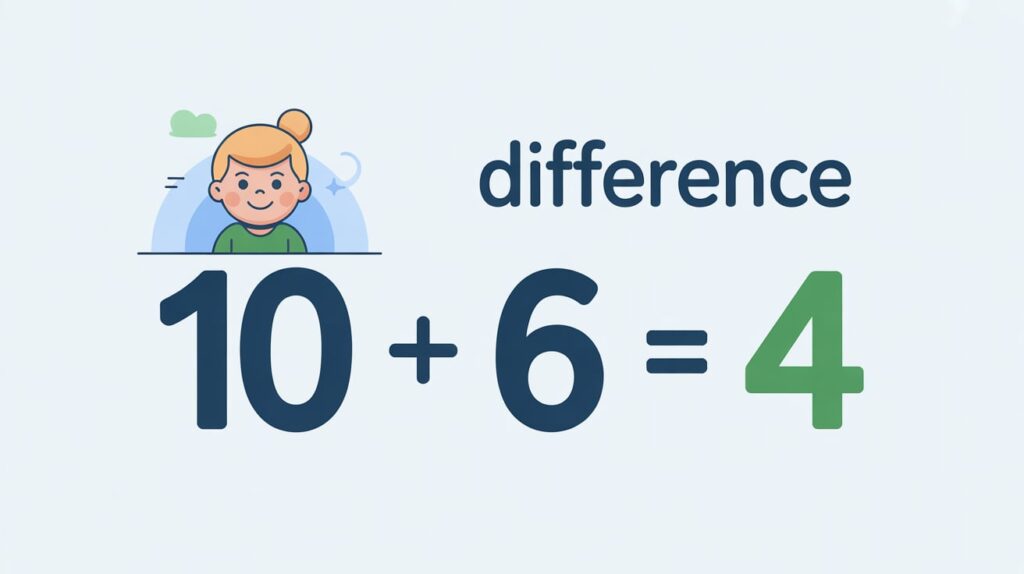
- The difference between 10 and 6 is:
10−6=410 – 6 = 410−6=4
Expanded Meaning in 2026
In modern mathematics education, difference can also refer to:
- The distance between two values
- The change from one quantity to another
- A comparison between values
- The result of subtraction, regardless of order (absolute difference)
So in 2026, difference is not just about “taking away”—it’s about understanding relationships between numbers.
Modern Usage of What Does Difference Mean in Math

As math education has evolved, so has the way difference is used and explained.
Where “Difference” Is Used Today
- Elementary arithmetic
- Algebraic expressions
- Word problems
- Statistics and data analysis
- Calculus (finite differences)
- Coding and algorithms
- AI and machine learning models
- Financial calculations
Examples Across Math Levels
Elementary Math
“What is the difference between 15 and 9?”
Algebra
“Find the difference between the expressions.”
Statistics
“The difference between the means is statistically significant.”
Data Science
“Calculate the difference between predicted and actual values.”
In 2026, difference is taught not only as a calculation, but as a conceptual tool for reasoning and analysis.
What Does Difference Mean in Math in Texting & Social Media
While math is formal, discussions about math now happen in text messages, online forums, social media, and learning platforms.
Common Digital Contexts
- Students texting homework questions
- Parents messaging teachers
- Online math help communities
- Educational TikTok and YouTube comments
- AI-powered tutoring chats
Examples in Texting
“What’s the difference between 8 and 3 again?”
“The teacher said find the difference, so I subtract, right?”
“Difference means minus in this problem.”
Social Media Usage (Educational Context)
“Math tip: ‘difference’ always means subtract 📘”
“People confuse sum and difference way too often.”
In 2026, the phrase what does difference mean in math is frequently typed into:
- Chatbots
- AI tutors
- Homework apps
- Search engines
- Classroom discussion boards
Examples of What Does Difference Mean in Math in Real Chats
Example 1: Student to Student
Alex: “What’s the difference between 14 and 5?”
Sam: “It’s 9—subtract the smaller from the bigger.”
Example 2: Parent Helping Child
“When it says ‘difference,’ you subtract.”
Example 3: Online Math Forum
“The difference between the two data points is 2.3 units.”
Example 4: Teacher Chat
“Remember, difference doesn’t mean sum.”
Example 5: Coding Context
“Find the difference between expected output and result.”
These real-life conversations show how difference is used across educational and professional environments.
Misunderstood Meanings of What Does Difference Mean in Math

Despite its simplicity, difference is one of the most misunderstood math terms.
Common Misconceptions
1. Difference Means Any Change
❌ Not always. In math, it specifically refers to subtraction.
2. Difference Is Always Smaller Minus Larger
❌ Usually, it’s larger minus smaller, especially in word problems.
3. Difference Means Distance Only
❌ Distance is one interpretation, but not the only one.
4. Difference Is the Same as Sum
❌ Sum means addition; difference means subtraction.
5. Difference Can Be Negative
⚠️ Depends on context. In some cases, yes. In others, the absolute difference is used.
Absolute Difference (Important in 2026)
∣a−b∣|\text{a} – \text{b}|∣a−b∣
This ensures the difference is always positive, especially in data science and statistics.
Why People Still Use What Does Difference Mean in Math in 2026
Despite advances in technology, the concept of difference remains essential.
Key Reasons
1. Foundational Skill
Subtraction and comparison are core math skills.
2. Universal Application
Used in finance, science, technology, and everyday life.
3. Critical Thinking
Helps analyze change and relationships.
4. Digital Relevance
Used in algorithms, AI training, and analytics.
5. Educational Consistency
Still appears in textbooks, exams, and standardized tests.
In 2026, difference is not outdated—it’s more relevant than ever.
Comparison Table: Difference vs Similar Math Terms (2026)
| Abbreviation | Full Form | Meaning | Usage Example | Popularity Score (2026) |
| Diff | Difference | Result of subtraction | “Find the diff” | 9.7/10 |
| Sum | Summation | Result of addition | “Find the sum” | 9.9/10 |
| Prod | Product | Result of multiplication | “Product is 24” | 9.5/10 |
| Quot | Quotient | Result of division | “Find the quotient” | 9.3/10 |
| Δ | Delta | Change or difference | “Δx = 5” | 9.8/10 |
2026 Context: How Difference Fits Modern Math Trends
Modern math education emphasizes:
- Conceptual understanding
- Real-world application
- Data literacy
- Computational thinking
- AI-assisted learning
The idea of difference fits seamlessly into:
- Machine learning error calculations
- Financial forecasting
- Statistical comparisons
- Scientific measurement
- Coding logic
In 2026, students often learn difference through:
- Interactive apps
- Visual graphs
- AI explanations
- Gamified learning
- Real-time feedback
Conclusion
So, what does difference mean in math?
In its simplest form, it means the result of subtracting one number from another. But in 2026, the concept goes far beyond basic subtraction. Difference represents comparison, change, distance, and analytical thinking across all levels of mathematics and real-world applications.
Whether you’re solving a first-grade worksheet, analyzing data, or training an AI model, understanding difference is essential. It remains one of the most important building blocks of mathematical thinking.
FAQ: What Does Difference Mean in Math?
1. Does difference always mean subtract?
Yes, in math, difference refers to subtraction.
2. Can difference be negative?
Yes, depending on order. Absolute difference removes negatives.
3. Is difference the same as change?
Sometimes, but not always.
4. Why do word problems use “difference”?
To test understanding of subtraction and comparison.
5. Is difference still taught in 2026?
Absolutely—it’s foundational.
Final Summary
The phrase what does difference mean in math continues to be relevant because difference is a core mathematical idea. In 2026, it represents subtraction, comparison, and change across education, technology, and everyday life. Understanding it clearly helps prevent confusion, improves problem-solving skills, and builds a strong foundation for advanced math concepts.