
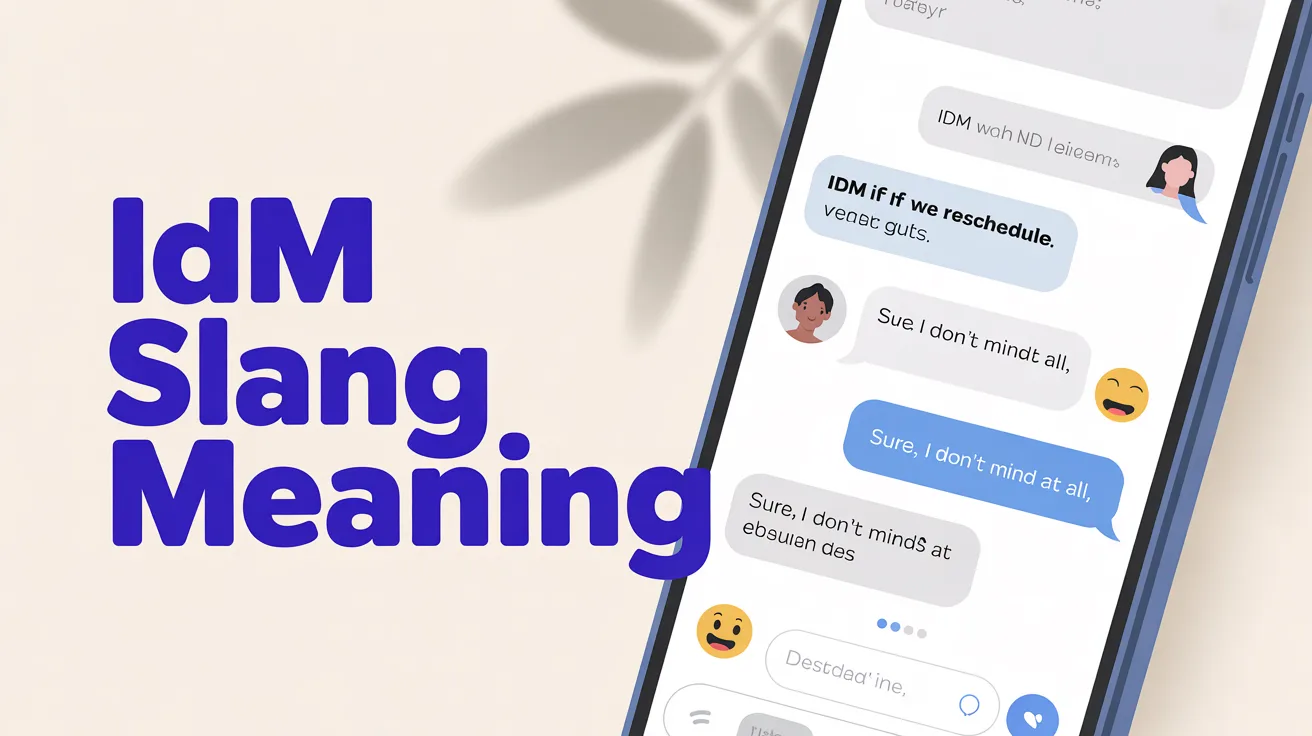
1. Why People Search “IDM Slang Meaning”
If you’ve seen “IDM” pop up in a text message, comment, or chat and thought, “Wait… what does that even mean here?” — you’re not alone.
People search “IDM slang meaning” because IDM is one of those short letter combinations that looks simple but carries multiple meanings, depending on context, tone, and platform. In modern digital communication, especially after 2025, abbreviations have become faster, looser, and more context-dependent than ever.
Texting habits today are shaped by:
- Short-form messaging (DMs, comments, replies)
- Multitasking across apps
- A growing mix of native and non-native English speakers
- Keyboard shortcuts and predictive typing
This article clears up the confusion once and for all. You’ll learn what IDM means in text, where it comes from, how people actually use it, when it’s appropriate (and when it’s not), and how to avoid misreading it.
By the end, you’ll know exactly how to understand — and use — IDM without sounding awkward, rude, or out of place.
2. What Does “IDM Slang Meaning” Mean in Text?
The Primary Meaning of IDM in Text
In texting and online chat, IDM most commonly means:
“I Don’t Mind.”
This is the dominant slang meaning in casual digital communication.
Literal Meaning
- I = I
- D = Don’t
- M = Mind
So, “IDM” is a shortened way of saying “I don’t mind.”
Implied Meaning in Conversation
While the literal meaning is neutral, the implied meaning depends heavily on context:
- Agreement without strong enthusiasm
- Indifference or flexibility
- Willingness to go along with someone else’s choice
Example:
“Pizza or burgers?”
“IDM.”
This usually means:
“I’m okay with either. You choose.”
When IDM Does Not Mean What People Assume
Some people mistakenly think IDM means:
- “I don’t mean” ❌
- “I do mind” ❌
- A random typo ❌
In slang usage, IDM almost never means those things. If someone uses IDM in a sentence where “I don’t mind” doesn’t fit, it’s either:
- A typo
- A different acronym (rare)
- Or a misunderstood context
3. Is “IDM” a Slang, Typo, or Intentional Usage?
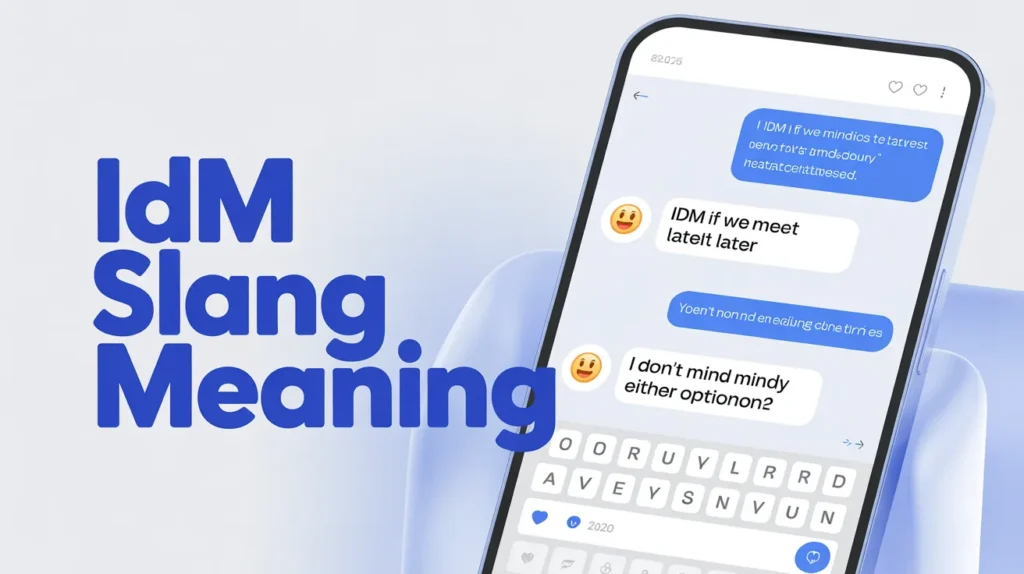
IDM as Slang
Yes — IDM is intentional slang in most cases. It’s part of the broader trend of:
- Removing filler words
- Compressing full phrases
- Prioritizing speed over grammar
It sits alongside terms like:
- IDK (I don’t know)
- IDC (I don’t care)
- IMO (In my opinion)
Typing Behavior & Keyboard Influence
IDM is popular because:
- It’s easy to type with one hand
- It avoids autocorrect issues
- Predictive keyboards often suggest it
On mobile keyboards, “IDM” is faster than typing “I don’t mind”, especially mid-conversation.
Intentional Stylistic Usage
Some people use IDM to:
- Sound casual
- Avoid sounding overly eager
- Keep emotional distance
How to Tell the Difference Using Context
Ask yourself:
- Is someone responding to a choice or suggestion? → Likely “I don’t mind”
- Is the tone neutral or flexible? → IDM fits
- Does replacing it with “I don’t mind” make sense? → Then that’s the meaning
Context almost always confirms it.
4. Origin and Evolution of “IDM” in Digital Communication
Early Chat and SMS Influence
IDM traces back to:
- Early SMS texting (character limits)
- MSN Messenger, Yahoo Chat, IRC
- Early smartphone messaging
Short phrases were shortened out of necessity, not style.
Social Media and Instant Messaging Evolution
As platforms evolved:
- Twitter/X character limits reinforced brevity
- WhatsApp, Snapchat, and Instagram normalized abbreviations
- Group chats encouraged faster replies
IDM became a functional shortcut, not just slang.
How Younger Generations Shaped Usage
Gen Z and Gen Alpha:
- Normalize minimal responses
- Prefer neutral flexibility
- Use short replies to avoid over-committing
IDM fits perfectly into that communication style.
Why IDM Still Exists in 2026
Even with voice notes and AI typing:
- Speed still matters
- Neutral replies reduce social pressure
- Short responses feel less emotionally loaded
IDM survives because it’s efficient and socially safe.
5. Real-World Usage Scenarios (Detailed Examples)

a) Casual Friend Conversations
Tone: relaxed, neutral, cooperative
Examples:
“Movie or series tonight?”
“IDM, you choose.”
“We can meet at 6 or 7.”
“IDM tbh.”
Here, IDM signals flexibility without strong preference.
b) Workplace & Professional Chat (Formal vs Informal Teams)
Tone: cautious, context-dependent
Informal team chat:
“Should we move the meeting to Friday?”
“IDM if that works for everyone.”
Formal or corporate settings:
- IDM may feel too casual
- “I don’t mind” is usually safer
Professional alternative:
“I’m flexible either way.”
c) Social Media, Gaming, and Online Communities
Tone: fast, casual, often low-context
Gaming chat:
“Ranked or casual?”
“IDM.”
Comment sections:
“Dark mode or light?”
“IDM tbh.”
In these spaces, IDM feels natural and expected.
6. Emotional Tone and Intent Behind “IDM”
Friendly vs Neutral vs Awkward
- Friendly: “IDM 😊”
- Neutral: “IDM.”
- Awkward or cold: “IDM” (no context, no follow-up)
How Punctuation and Emojis Change Meaning
- “IDM!” → upbeat, open
- “IDM…” → hesitant or passive
- “IDM 👍” → agreeable and positive
When It Feels Warm vs Careless
Warm:
“IDM, happy either way!”
Careless:
“IDM.” (as a final response)
Tone isn’t in the letters — it’s in the delivery.
7. Cultural and Regional Differences in Usage
Native vs Non-Native English Speakers
- Native speakers often read IDM as casual
- Non-native speakers may read it as dismissive
That’s why IDM can sometimes cause confusion internationally.
Regional Texting Habits
- US / UK: IDM is common in casual chat
- South Asia: Used, but often mixed with full phrases
- Europe: More common in gaming and online spaces
Cross-Platform Language Adoption
IDM spreads faster on:
- Discord
- WhatsApp groups
- Gaming chats
Less common in:
- Emails
- Formal customer support
8. “IDM” Compared With Similar Texting Terms
| Term | Meaning | Tone | Formality | Best Use |
|---|---|---|---|---|
| IDM | I don’t mind | Neutral | Casual | Flexible replies |
| IDC | I don’t care | Dismissive | Very casual | Close friends only |
| IDK | I don’t know | Neutral | Casual | Uncertainty |
| IMO | In my opinion | Thoughtful | Semi-casual | Sharing views |
| Sure | Agreement | Friendly | Neutral | Polite acceptance |
IDM is softer than IDC and more flexible than “sure.”
9. Common Misunderstandings and Mistakes
Misinterpretation Cases
- Assuming IDM means lack of interest
- Reading it as passive-aggressive
- Confusing it with a typo
Autocorrect and Keyboard Issues
Some phones auto-suggest IDM unintentionally, leading to:
- Unclear replies
- Tone mismatches
Overuse Problems
Using IDM too often can make you seem:
- Unengaged
- Indifferent
- Emotionally distant
How to Avoid Confusion
Add a follow-up:
“IDM — both sound good.”
10. Is “IDM” Polite, Rude, or Unprofessional?
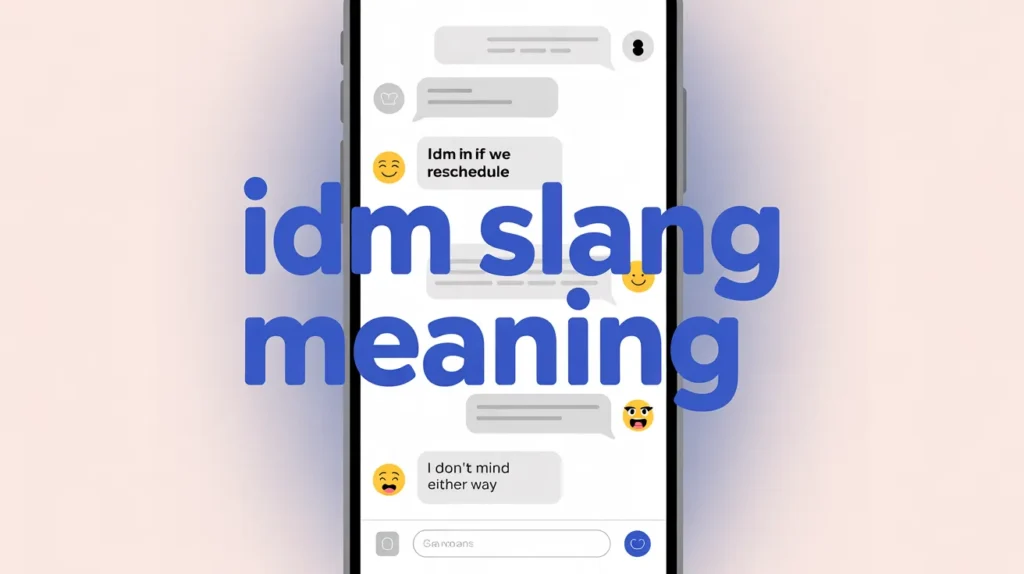
Relationship-Based Analysis
- Close friends: Polite and normal
- Acquaintances: Neutral
- Strangers: Can feel cold
Context-Based Analysis
Casual chat → acceptable
Professional email → avoid
Professional Etiquette Guidance
Instead of IDM, use:
- “I’m flexible”
- “Either option works for me”
11. Expert Linguistic Insight (Text Language in 2026)
Digital language evolves toward:
- Efficiency
- Emotional safety
- Reduced friction
Abbreviations persist because they:
- Lower effort
- Reduce over-commitment
- Match fast digital rhythms
Grammar matters less in chat — clarity matters more.
12. How and When You Should Use “IDM”
Do’s
- Use with friends
- Add context when needed
- Match the other person’s tone
Don’ts
- Use in formal emails
- Use alone in serious conversations
- Overuse it
Safer Alternatives
- “I’m okay with either”
- “No strong preference”
- “Up to you”
13. FAQs About “IDM Slang Meaning”
1. What does IDM mean in texting?
It means “I don’t mind.”
2. Is IDM rude?
No, but it can feel cold without context.
3. Is IDM the same as IDC?
No. IDC sounds dismissive; IDM is neutral.
4. Can IDM be used professionally?
Only in very informal work chats.
5. Does IDM mean the person doesn’t care?
Not necessarily — it usually means flexibility.
6. Why do people use IDM instead of full sentences?
Speed, convenience, and casual tone.
7. Is IDM still used in 2026?
Yes, especially in chat-based platforms.
14. Final Summary and Key Takeaways
IDM slang meaning is simple but context-heavy. It stands for “I don’t mind” and signals flexibility, neutrality, or quiet agreement. While it’s common and harmless in casual texting, tone and setting matter.
Used thoughtfully, IDM keeps conversations smooth and pressure-free. Used carelessly, it can feel distant. Context is everything.